In the mid-October of 2009, Prof. Thurston showed us the detail drawings of the “8 Geometry Link models as Metaphor of the Universe” They inspired us to make the collection based on them, accompanying design study with rope and toile. Considering the body itself as the Universe, we have added our own interpretation of beauty to them. The new perception of the body shared by all the members of the team resulted in the discoveries of new lines and forms, which were then applied to textile, color and detail studies. Thus the new collection has taken shape steadily, revealing its whole picture eventually. To sum up the exchange with Prof. Thurston led us to find a completely new kind of beauty and embody it in clothing. This mission was, as it were, an odyssee to explore the Universe with infinite imaginations.
The geometrization conjecture roughly says (I am not an expert on this) that a three dimensional volume form without boundary (a two dimensional analog of such a form would be for example the surface form (i.e. the “skin”) of a ball or the surface form of a doughnut) can be decomposed into “pieces” which have one of 8 characteristic “geometric structures”, which means roughly that in a small neighbourhood of any such “piece” there is – out of only 8 characteristic ways – one specific way to measure length. A theorem states that any three dimensional (oriented) volume form without boundary can be obtained by cutting a “thick” (that is instead of a rope take a ribbon) link out of a three dimensional sphere. Thus you can characterize special types of three dimensional volume forms (here: “the pieces”) by assigning a link to them. This is – by what I understood sofar- why there are 8 links (or link models) on the poster – they characterize the 8 types of possible “pieces”, which built up three dimensional volume forms without boundary.
Why do they call these 8 links “Metaphor of the Universe”? I can only make wild guesses, which sound rather like science fiction than science: Maybe if you imagine the space of the universe to be eventually such a three dimensional volume then by cutting it into pieces (may be along black hole horizons huh?!) and “measuring distances” (determine a metric) one could make deductions about the actual form of the universe? Or – reversely by making assumptions about the form of the universe (like e.g. that its space is a three sphere) one may get informations about what could be inside black holes…given that one finds all black holes…(this is just a funny joke).
But joking aside – I think they call it Metaphor of the Universe because these simple 8 links may be used to describe quite complicated things.
BerliNordik is a rather new forum for sustainable design, it is
“an international platform that brings together young talented designers from Berlin with their colleagues from the Nordic countries on the subject of sustainable design. “
The berliNordik blog informs amongst others about activities of BerliNordik. Recently BerliNordik coorganized an exhibition called “Bright green design” where I attended the opening. For the exhibition few product design objects were chosen. I actually had also sent in a proposal but unfortunately -again- it wasn’t chosen (maybe I write later about that project in product design). Below some images from the opening.
There are images from three projects in the images. One project is featuring a partially wooden bike called “Holzweg”. Here I was asking myself how good the different material components can be dissassembled. Another project is the Yellowone Needle Cap – a protective cap that turns an empty soft drink can into a safe depository for used needles, by Hân Pham. The third project is “Spot on the BUOY” by Adrian Paulsen. In this envisaged project a buoy is supplied with a paper towel for oil spills and e.g. lights so that the buoy acts as a kind of sensor for oil spills. Clearly the buoy would only be appropriate for rather “light” spills it would certainly not be addaped for the recent oil spills in the gulf of Mexico. Any paper would be totally overstrained with this spill.
In the below images you can see also the discussion of jury members and organizers about “what is green design“. One key issue here was the quandary of eco-designers, which is that to a great extend the task of a designer is to communicate a product and thus in part to encourage more consumption, which is against sustainability. It is also in part the task of an eco-designer to greenwash a product. Last but not least sustainability is often in conflict with economic interests, i.e. due elaborate production methods and materials and e.g. longer durability often only small profits can be made which is a problem in our economic system. Moreover next to the demand of incorproating new green technologies, questions about certification of eco-efficiency, compliance to new standards etc. are making the design process difficult.
->Video of the opening
Interview by Lilli Green with visitors of the exhibition about “what is green design” (-> video)
Short notice: as published in one of the current gazettes (2010-04-20) of the US Trade mark office the company Disney had filed an application for the name “snow white” (if I understood correctly ?) for:
Production, presentation, distribution, and rental of motion picture films; production, presentation, distribution, and rental of television and radio programs; production, presentation, and rental of sound and visual recordings; production of entertainment shows and interactive programs for distribution via audio and visual media, and electronic means; production and provision of entertainment in the nature of shows, current events news, and entertainment information via communication and computer networks; amusement park and theme park services; educational and entertainment services rendered in or relating to theme parks, namely, live stage shows, live amusement park shows, live performances by costumed characters, and presentation of live theatrical performances; presentation of live stage shows; presentation of live show performances; entertainment in the nature of theater productions; entertainer services, namely, live appearances by a professional entertainer
On our flight back from Japan I had the opportunity to watch something that was probably originally a TV program. I do not speak japanese, nevertheless I think one can grasp a bit that the program was a kind of edutainment program promoting mathematics. One sees that the participants of the program have to solve some basic arithmetic problems in a kind of game. I am not sure wether the geometric patterns in the background indicate that maybe even higher mathematics was involved.
Also if the playful enthusiasm of the participants in the images may look a bit foreign to matter-of-fact europeans I found it interesting to see how some countries communicate mathematics in the public.
supplement on may 7th: I was asked wether I could give more details on the program I am promoting here. Unfortunately I couldnt find any details in the airlines (LH) newsmagazine about it, may be some japanese fluent person can say something?
It is quite arrogant to say that such a design is bad – just because you have other criteria! You say your comment shouldnt be seen as an insult, but of course it is an insult! Even worse you discredit the makings of a different country than your country of origin, you should have a better respect of other cultures! Your comment may sound very disheartening!
My reply to this and some more photos from the Juno oven (see above) which works without dripping pans (the drip goes onto the outer surface and is not collected in a dripping pan) after the click. (more…)
I couldnt resist buying the above fashion item from a bargain-bin in Fukuoka, since it is on one hand a refreshing example of language use, but secondly because it displays an interesting connection between garment and power (here in a highly agressive way though). The T-shirt had been made by a factory called Slap Stick.
“End of Liberty”, artist: Endengelman John Glonnriff”
Vlad Alexeev had created a website called Impossible World which collects “impossible figures”, from Vlad Alexeev’s website:
Since some time I became interested in such artworks and figures that look usual at a first sight, but there is something wrong with them if you look at them more attentively. For me, the most interesting such figures are “impossible figures” which make an impression that they cannot exist in a real world.
I wanted to know more and tried to find some information about these figures in the Internet. I found numerous sites containing three or four different impossible figures, but there was no site devoted exclusively to the study of impossible figures. During this pursuit I made the acquaintance of impossible figures of Swedish artist Oscar Reutersvärd and images of Dutch artist M.C. Escher.
It has been icy and cold the last days in Berlin with a lot of snow (see above image from today). In an earlier randform post I indicated that there is quite a lot to tell about badly built US houses. Like, when living in New England, it happened one cold day that the dishwasher didnt work. It took us quite a while to find the reason. The reason was that a pipe, which was INSIDE the house, however too close to the outer wall, froze. Yes you understood correctly – the insulation of the house was so sparsely that this pipe froze inside the house!
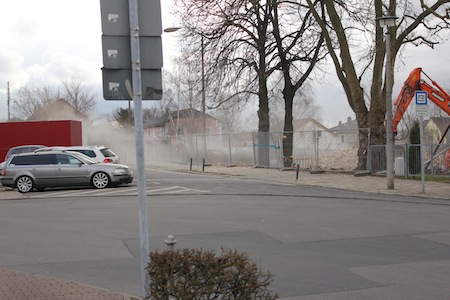
But back to the image – if you ever wondered what these strange signs on lamp posts and trees in Germany may mean (like the blue sign in the image above which you see if you follow the arrow). These signs are giving a detailled description of hydrants and facilities for water, natural gas, district heat and electricity use. So the above sign in the image should indicate a water gate (SCHIEBER in german). This sign methodology makes it considerably easy to detect frozen and/or broken pipes in the soil. Hopefully there will be a change in the US regarding the saving of energy, otherwise one should may be think about developping a sign methodology for frozen pipes inside US houses…