Archive for the 'math' Category

poincare oddyssee

Wednesday, July 7th, 2010

poincareodyssee0-IMG_8786-450
poincareodyssee1-IMG_8785-450


Last time when I was in Göttingen I found a poster at the math department documenting an art science collaboration between mathematics professors William Thurston, Kazushi Ahara and Sadayoshi Kojima on one side and a team around clothing designer Issey Miyake, notably including chief designer Dai Fujiwara of Issey Miyake (here a link to a partial version of the poster, see also absnews article by Jenny Barchfield). A result of this collaboration is that the Issey Miyake Fall-Winter 2010-2011 ready-to-wear collection is inspired by the geometrization conjecture.

From the poster:

In the mid-October of 2009, Prof. Thurston showed us the detail drawings of the “8 Geometry Link models as Metaphor of the Universe” They inspired us to make the collection based on them, accompanying design study with rope and toile. Considering the body itself as the Universe, we have added our own interpretation of beauty to them. The new perception of the body shared by all the members of the team resulted in the discoveries of new lines and forms, which were then applied to textile, color and detail studies. Thus the new collection has taken shape steadily, revealing its whole picture eventually. To sum up the exchange with Prof. Thurston led us to find a completely new kind of beauty and embody it in clothing. This mission was, as it were, an odyssee to explore the Universe with infinite imaginations.

The geometrization conjecture roughly says (I am not an expert on this) that a three dimensional volume form without boundary (a two dimensional analog of such a form would be for example the surface form (i.e. the “skin”) of a ball or the surface form of a doughnut) can be decomposed into “pieces” which have one of 8 characteristic “geometric structures”, which means roughly that in a small neighbourhood of any such “piece” there is – out of only 8 characteristic ways – one specific way to measure length. A theorem states that any three dimensional (oriented) volume form without boundary can be obtained by cutting a “thick” (that is instead of a rope take a ribbon) link out of a three dimensional sphere. Thus you can characterize special types of three dimensional volume forms (here: “the pieces”) by assigning a link to them. This is – by what I understood sofar- why there are 8 links (or link models) on the poster – they characterize the 8 types of possible “pieces”, which built up three dimensional volume forms without boundary.

Why do they call these 8 links “Metaphor of the Universe”? I can only make wild guesses, which sound rather like science fiction than science: Maybe if you imagine the space of the universe to be eventually such a three dimensional volume then by cutting it into pieces (may be along black hole horizons huh?!) and “measuring distances” (determine a metric) one could make deductions about the actual form of the universe? Or – reversely by making assumptions about the form of the universe (like e.g. that its space is a three sphere) one may get informations about what could be inside black holes…given that one finds all black holes…(this is just a funny joke).

But joking aside – I think they call it Metaphor of the Universe because these simple 8 links may be used to describe quite complicated things.

->wikipedia link math and fiber arts

Days of Harmonics

Monday, June 28th, 2010

futureshapes450

The International society for the interdisciplinary study of symmetry ISIS (not to confuse with Isis Healing or other Isis disambiguations) is soon organizing a conference called “Days of Harmonics” (Regular registration fee: 400 Euro) (Aug. 23 – Aug.28 2010, AUSTRIA). The proceedings are probably going to be published in the journal visual mathematics by the mathematical institute Belgrade.

mathpromo

Monday, April 19th, 2010

On our flight back from Japan I had the opportunity to watch something that was probably originally a TV program. I do not speak japanese, nevertheless I think one can grasp a bit that the program was a kind of edutainment program promoting mathematics. One sees that the participants of the program have to solve some basic arithmetic problems in a kind of game. I am not sure wether the geometric patterns in the background indicate that maybe even higher mathematics was involved.
Also if the playful enthusiasm of the participants in the images may look a bit foreign to matter-of-fact europeans I found it interesting to see how some countries communicate mathematics in the public.

supplement on may 7th: I was asked wether I could give more details on the program I am promoting here. Unfortunately I couldnt find any details in the airlines (LH) newsmagazine about it, may be some japanese fluent person can say something?

club1-IMG_0613-450club2-IMG_0610-450club3-IMG_0614-450club4.5-IMG_0616-450club4-IMG_0612-450club5-IMG_0603-450club6-IMG_0604-450

about inspection optimization in nuclear energy

Friday, December 4th, 2009

In an earlier randform post about scaling factors in nuclear power generation I tried to explain what is implied if nuclear power generation is going to be increased. Among others I was talking about the risk of a nuclear accident which is going to rise by scaling things up. An important quantity in risk assessment in nuclear power generation is the core damage frequency. The corresponding Wikipedia article links to a ressource by the Electric Power Research Institute by which the probability of a damage of the nuclear core was in 2005 (i.e. the more dangerous type of fast breeder reactors, which will dominate in the future is included in this average only to a small amount) at 2*10^(-5)=0.00002 per reactor and year (there seem to be ressources which indicate that this frequency may be higher though).

This means that is if one has approx. 500 reactors worldwide the likelihood of a core damage somewhere in the world was in 2005 one damage in 100 years, if we take again a factor ten as in the randform post about scaling factors in nuclear power generation then this would rise to one core damage every 10 years. If we include an higher risk for fast breeders (which is a technology, which hasnt been tested exhaustively) then this likelihood rises again. Core damages are quite crucial because they can lead to a nuclear meltdown.

Other risks are therefore often calculated in relation to the core damage frequency. While answering to a comment about Leukemia I stumbled upon the “Studies on Applying Risk Informed In-Service Inspection for Indian Nuclear Power Plant and Heavy Water Plant” by G. Vinod from the reactor safety division at the indian Babha Atomic Research Centre in which probabilistic safety assessment techniques for indian nuclear power plants which among others are using the core damage frequency are discussed in particular with regard to optimizing inspection. A citation from the article

An optimum plan should be devised subjected to constraints such as risk to plant, cost of inspection and radiation exposure to workers, if the component is in radioactive area.

Its not clear to me to what extent inspection optimization may lead to an increase of the core damage frequency.

about reputation

Tuesday, September 29th, 2009

knee250.jpg

In a comment about a recent study whose neutrality was not so clear I was asked by a reader:

If there is all this data as you say on the internet then why do you need this reputation thing at all, i mean can’t you just check wether this Greiser person is right?

The study which the reader meant to be checked used data about leukemia occurences in children who lived in the vicinity of a nuclear power plant. This data was -to a great extend- gathered together via the internet and was then statistically evaluated. So the reader assumed that -given that all the necessary information is available- that one could just check wether the study is right.

My answer:
In principle -given that all information is provided in the study- and – given that oneself can access all data (this is unfortunately not always that easy) one can check wether all the in the study given data was correctly evaluated, one can follow the statistic reasoning and the methods which were used a.s.o. The question wether the study is correct or not should thus not be expected to be answered plainly with a yes or no, but at least include explanations about the involved methodology. All that takes a lot of knowledge and experience which is -for an outsider- not so easy to acquire. That is even though I am a mathematician it would take me probably quite some time to understand and evaluate the involved reasoning (it is not exactly my field), it is quite likely that I would end up with open questions and thus would need to consult other people.

One can compare this a little bit with a medical diagnosis, that is in principle all the medical information is available in text books, articles etc. and without having studied medicine one can have a “feeling” about how correct a diagnosis is, however – depending on the symptoms and ones own knowledge- people usually prefer to see a doctor instead of feeling inclined to cure themselves. The craftmanship of a mathematician -although this may not be so obvious- is comparable to that of a physician.

Nevertheless it happens that people won’t go see a doctor. This may happen because people can’t afford to pay a doctor and/or because they are convinced that their methods (or those of a non-medical-doctor) are better. And there are indeed cases were non-doctors may have better results. Nevertheless the typical scenario is that a learned doctor knows more and can help you better than a non-doctor. This holds also true for “crowd knowledge” that is you may ask around in fora about what to do with what symptoms, but typically you wouldnt like to rely on them completely.

Here one should note an important feature: Among others a doctor is someone who was evaluated by a certain group of people who know the subject. That is professional organisations, universities etc. hand out certificates which should give you some trust that this person knows what he/she is saying and doing. This is mostly what reputation is about. It is a guideline. Or put differently: Given a specified task the chance that you will end up with a completely incapable person which had been certified for this task by a respectable institution should be smaller than the chance that an uncertified person is incapable. This doesnt exclude the case that there are uncertified persons with a better knowledge than certified ones. This is just -at the moment- on average less likely.

I wrote “at the moment”, because there are unfortunately tendencies which dilute this rather helpful feature, as can be seen e.g. in the certification problem in the already mentioned outsourced learning environments/online classes. Certification problems can also be found in “cheap education” e.g. by certifying large amounts of students, which makes cheating easier (for example by handing in essays, which were not authored by oneself), academic misconduct and/or corruption e.g. due to financial interests etc. Moreover the possibilities for free autonomous learning are much, much better than before (which is good), so the number of highly trained individuals without a certificate are most probably on the rise. Traditional systems of evaluation may thus be loosing their influence. Personal recomendations would thus become more important, which makes it on the other hand harder to enter a foreign field as an outsider.

The above (unemployed) patient in the foto had a bad bike accident, which resulted unfortunately not only in a torn muscle. Thanks to a “still” rather good medical care in Germany within one week and with the help of several specialists and MRI a not so common injury could be diagnostized fastly and within 2 months the patient should be able to walk properly again….

Why do I write “still”?

Because in Germany the costs for health care are on the rise. This is not only due to an aging population but also to a great extend due to rising costs for pharmaceutical products, where new, patented products play a major role. According to this article in Berliner Zeitung on total the costs for physicians in Germany are meanwhile smaller than the costs for pharmaceutical products. Nevertheless suggestions of politicians which are about to form Germanys new government suggest to cut down on health care on the whole and instead secure a socalled “basic care” for the masses which could be supplemented by additional care – if you have the money. As a result the stockmarket for certain pharmaceutical companies soared right after the elections.

historical reading: -> hippocratic oath

College for $99 a Month

Wednesday, September 16th, 2009

boneintheglamaroususa450.JPG

Just a quick link to an interesting article in the Washington monthly about possible future developments within the US and other high-tuition-dependent-educational systems ->College for $99 a Month

very, very short summary: the article explains that cheap online education (eventually outsourced to India etc.) may lure college students into taking standard classes in the internet instead of in a typical college. This development could be accelerated due to the economic crisis. Standard courses usually “nurture” the more specialized classes, hence it can be feared that the overall quality may suffer from this.

pixillation

Thursday, September 3rd, 2009


graphics looking as from cellular automata (game of life?) and fluids in a psychadelic 1970 animation by Schwartz and Knowlton.
via dataisnoture

commander YYY is watching you

Wednesday, July 29th, 2009

omnitrunc5cell450.JPG

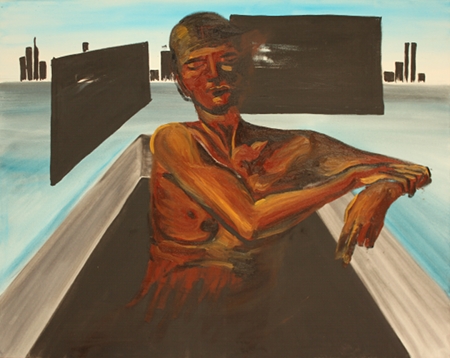
“commander YYY is watching you” pencil, aquael color pencil, silhouette, artwork by tamchudessatamleshebrodit

(more…)

detexify

Saturday, July 25th, 2009
smile.png

I am thinking about syntax, equation representation and display, symbolic computations, and all that stuff a lot lately. Now by chance I stumbled over somewhat the reverse process (via micromath):
detexify, a nice little tool that lets you draw a symbol and (hopefully) retrieve the corresponding LaTeX command for it. Mathematical formula recognition seems to be a beast of its own kind, still it would be nice to have sort of an electronic scratch paper on wich you can scribble your formulas and the system reads them and checks them for validity.

aligned with the big bang

Sunday, July 5th, 2009

parisfoucault1450jpg.JPG

(more…)