To those who are not aware of the fact: The main authors of this randform blog (Tim and Nad) are math Ph.D.’s. Since now quite a while we are very concerned about the fact that (pure) math research is increasingly put under high retrenchment pressure. So for example under the name of “shaping for excellence”, the University of Leicester will decrease its fundamental research capacity. For “pure” math this means: the University VC (=vice chancellor) proposes to cease research in pure mathematics and wants again to fire all researchers. It is claimed that this is necessary because: “…to ensure a future research identity in AI, computational modelling, digitalisation and data science requires ceasing research in Pure Mathematics in order to invest and extend activities in these areas.”
For those who know about the mathematics behind AI, computational modelling and digitalization this sounds not only absurd but rather like to cut one’s nose to spite one’s face. But it seems things are even worse that is this “triage” seems to be a pretense as they give no concrete plan “to invest or extend activities” but just to cut in fundamental mathematics research.
As a matter of fact this plan affects a high amount of female researchers. In fact by comparing with the list of academic staff (I count 39 academic staff members) and/or the list of group members in “applied math” and/or the list of women in mathematics on the equal opportunites web page it seems all women but 3 of Leicester’s math department are going to be fired.
In the randform post “Gesture steered Turing machine” I used data gloves, which were made following the instructions of Hannah Perner-Wilson who is a member of the gloves project. Being weary of sitting too much at the computer I had also written in this post that I would like to make more use of body movements and in particular include danse-like movements in computer interaction and in particular in programming.
Unfortunately rather shortly after I had written the post a not so nice medical indication in my vicinity which was -at least partially- due to too much computer sitting urged me to more or less dramatically speed up this project.
The gesture recognition for my gloves, which were used in the Turing machine example, works, but it is not yet fine grained and exhaustive enough. So I had to look for an easy and fast and at least to some extend workable and affordable solution which would insure a more direct and precise steering possibility, like some version of key gloves. To make it short: In the end I made my own version with Tims help. Again it’s only a start but still.
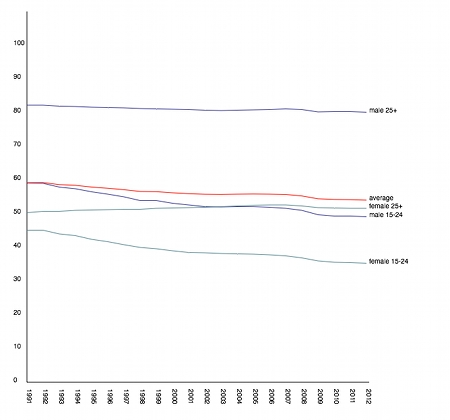
I am still collecting data on global employment in order to better investigate the replacement of human work by machines. Unfortunately it turned out that the International Labour Organisation (ILO), which holds most of the original data restructured their IT-sector. This means in particular that some older data can’t be reproduced any more. Above you can see that the worldwide employment went down on average since the nineties. I keep the data now here locally on our account as a copy from ILO in order to keep the findings reproducible. The data source as well as the source code for extracting it (GPL) are here. As always: if you spot some mistakes please let me know.
For those who are interested there is a discussion about determinism and freedom, free will, privacy etc. at the blog backreaction following a post with the title: 10 Misconceptions about free will, which I found problematic. If you want to know more you may read my comment also after the klick.
The Rapid Miner LOD extension was amongst others used by the winners of the Semantic Statistics Challenge. The winner’s slideshare link hosts some examples, like maps which investigate the correlation between unemployment and police stations in France, which display a bit the capabilities of the involved programms and databases.
The National Bureau of Statistics teamed up with 11 high-tech firms to use big data technology in the collecting, processing and analyzing of important statistics.
and
Under this partnership, the bureau and the 11 companies will co-develop a standard on how to use big data in statistics.
So it will be interesting to see wether some of this high tech data will enter the Linked open data pool and wether we will get to see soon some interesting visualizations of it.
Here you get an exclusive look behind the randform (iron ;)) curtain:
Tim’s latest free time projects were heavily located in music electronics. His last weekend project was to use a socalled x-OSC chip (which he is currently beta testing) by the british company x-io technologies (see blue blinking board in the video) as a wireless remote control for a socalled ladder filter (unfortunately a bit hard to see in the wirings on a kitchen table…).